
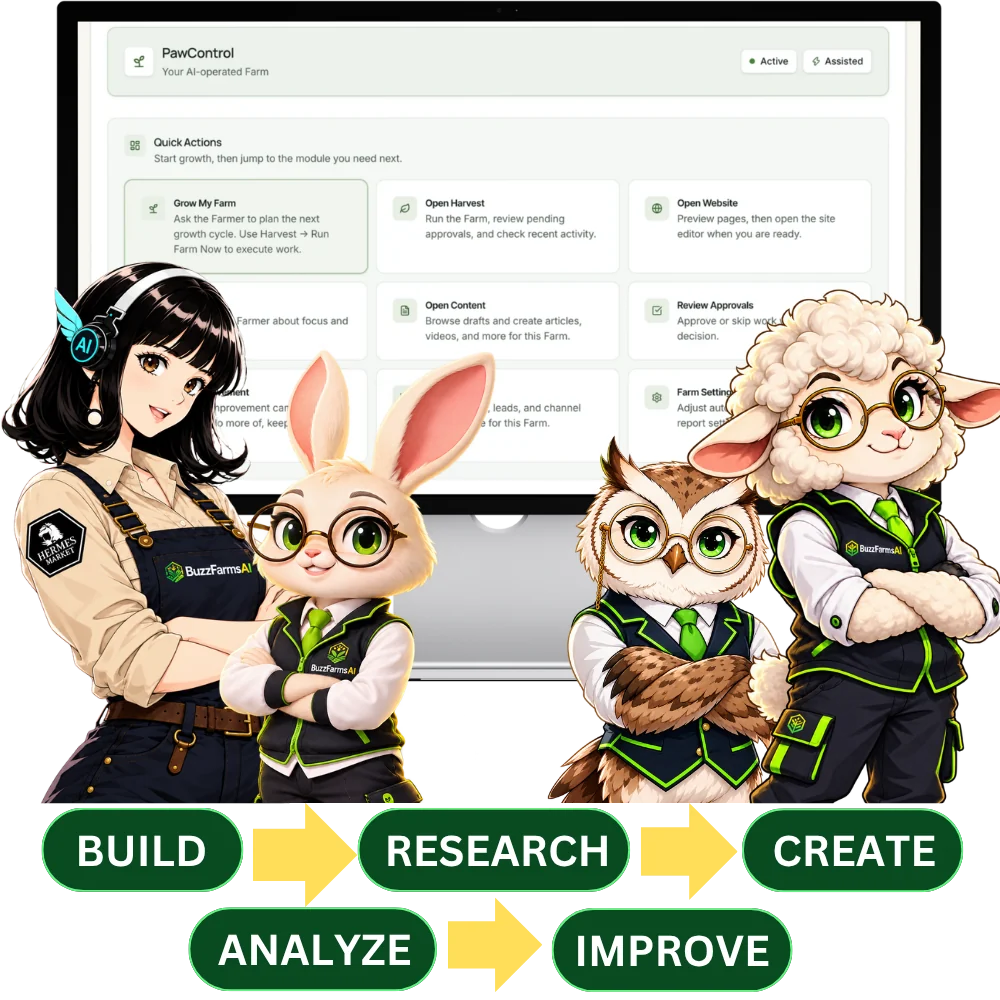
One goal, different responsibilities
The Farmer-and-Farm-Hands model separates coordination from execution. A coordinator keeps the property's audience, offer and objective in view; workers handle narrower activities. That can be more coherent than asking unrelated tools to produce a page, an article and a promotion without a shared brief.
The seller describes Hermes-powered infrastructure underneath this workflow. That identifies the advertised agent foundation, not a guarantee of reasoning quality, reliability or an independently verified technical configuration. The useful buying question is whether the complete workflow fits the work you actually need to manage.
The Farmer's advertised purpose is to keep a business objective connected across several kinds of work. That matters because a marketing project often becomes fragmented: the page uses one description, a promotional draft uses another, and later changes are not reflected everywhere. A coordinator with shared context could make the relationship between those outputs easier to manage. It is a practical organizational benefit to examine, rather than proof that the system reasons correctly in every situation.
A useful coordinator should receive a bounded assignment. For an example service property, specify the actual services, the intended audience, the next action and the facts that must remain consistent. You should be able to recognize whether the specialist outputs support that assignment. If the objective is simply “make the business grow,” almost any additional content can appear relevant, making both review and measurement harder.
For the broader buyer decision, read our full BuzzFarmsAI assessment.
What the Farm Hands do
The official overview groups work into the roles below. These are documented responsibilities, not a promise that every subscription exposes the same controls or allowances. The coordinator is valuable only when these handoffs preserve the original brief.
Role names are helpful when they identify different responsibilities. The content worker prepares an explanation; opportunity research looks for relevant questions; distribution adapts approved material; analysis examines recorded activity. The same project still needs decisions about order and handoff. A draft should not be distributed before the facts it contains have been checked. A later analytical recommendation should not silently authorize a new external action.
Think of the Farmer as a way to organize those dependencies. You can ask why a proposed article belongs in the property, which audience question it answers and what evidence supports it. This makes the agent structure relevant to a real operator. It also gives you a way to reject work that sounds plausible but does not contribute to the project, rather than approving every generated suggestion because it came from a named specialist.
| Role | Advertised responsibility | Human review question |
|---|---|---|
| Site worker | Build and improve Farm pages | Does the structure match the reader's next decision? |
| Content worker | Prepare articles and other marketing material | Are the claims supported and the draft useful? |
| Opportunity worker | Research relevant audience conversations | Is this a suitable place to contribute? |
| Distribution worker | Publish, schedule or prepare contributions | Is this action authorized for this destination? |
| Analyst | Review Harvest signals and suggest next activity | Is there enough evidence to justify the change? |
To see these responsibilities in sequence, follow the complete Farm workflow.
Choose around one clear marketing project
Match the connected Farm workflow to your audience, project scope and review capacity. The pricing guide explains the commercial details that still need confirmation.
View the BuzzFarmsAI offerMemory is not model training
Persistent Farm memory is described as retaining the offer, audience, instructions, earlier content and lessons from performance. In practical terms, the intended benefit is continuity: a later task should not need the entire project explained again.
Retained context does not establish that the underlying AI model is being retrained. Nor does it prove that every remembered conclusion is correct. A mistaken product specification or outdated offer can be repeated consistently too. Keep an approved source brief, identify the version that is current and review important changes rather than assuming memory makes them reliable.
Storage location, retention periods, deletion options and access boundaries need product-specific confirmation. Do not upload confidential client material simply because a workflow can accept files or URLs.
Persistent context is particularly useful when the same business facts would otherwise be re-entered repeatedly. Service coverage, product limitations, writing preferences and approved destinations can inform later tasks. However, retaining information is valuable only if it remains accurate. A discontinued offer or an outdated instruction should not continue shaping new material. Keep a clear current brief and inspect how a material change affects later outputs.
The seller's use of Hermes technology and self-improvement language describes the intended coordination mechanism. It does not establish which underlying model is used for every task, how private data is handled or a measured rate of learning. Those details need product-specific answers when they affect your project. Do not upload confidential client information merely because the software advertises memory; permissions and privacy still need to fit the data you supply.
An illustrative handoff
Imagine a Farm explaining a garden-planning course. This is an example brief, not a recorded product run. The coordinator's objective is to help a beginner decide whether the course suits a small outdoor space. The content task is a sourced planting-calendar guide; the opportunity task looks for relevant beginner questions; distribution is restricted to an approved website and reviewed contributions.
The important handoff is not simply 'article finished.' It includes the audience, source links, unresolved climate assumptions and the permitted next action. If the content cannot support a regional recommendation, that uncertainty should reach the reviewer rather than disappearing when another worker takes over.
Imagine a product-comparison Farm receives a verified change to an annual price. A useful handoff would identify the buying guide, comparison table and promotional explanation affected by that fact. The content task would revise the relevant passages, and a reviewer would check that billing is still explained accurately. Distribution would resume using approved wording. This is an illustrative process for evaluating coordination, not a verified automatic update feature.
Now consider a weak handoff: an analyst sees more clicks and asks for more pages without checking whether the visitors are relevant. That can increase activity while leaving the real objective untouched. Ask the Farmer to connect its proposed next task to an observation and an intended outcome. You then have something concrete to assess: why this task, why now, and what would indicate that the change helped?
Keep the assignment bounded
Start by defining a deliverable, an approval point and a stopping condition. More delegated tasks are not automatically more useful. A small, understandable workflow is easier to inspect and revise than a broad instruction to grow the business.
Define approval boundaries by consequence. Drafting an internal outline requires a different level of attention from publishing a price claim or sending a message from a business account. Assign a reviewer to public claims and external actions. Confirm which controls the selected plan actually supplies, and do not assume that a manual instruction overrides every possible recurring action until you have checked the available behavior.
This supervision can be lightweight when the project is well scoped. You do not need to rewrite every sentence to make the system useful. You need reliable source material, a clear decision standard and a way to stop or correct unsuitable work. BuzzFarmsAI is most attractive when coordination currently costs you repeated effort, and the generated outputs can be reviewed by someone who understands the business.
- Give the Farm one clear audience and business goal.
- Specify the evidence each worker should carry forward.
- Separate a prepared draft from permission to publish it.
- Review a recommendation before changing the strategy.
Before authorizing external actions, work through approval and permission planning.
When coordination is worth paying for
A solo creator with one occasional page may not need a large agent workflow. A creator maintaining several related materials may find a shared project context more valuable. The buying question is whether the Farmer reduces repeated briefing and helps keep work consistent enough to justify the cost and review time. Count the recurring tasks you already perform before assigning value to capabilities you may never use.
For an agency, coordination also needs a client boundary. Confirm how project information is separated, who may approve content and whether account access requires an upgrade. The product document advertises different client and agency allowances across packages. A general claim about commercial site creation does not automatically establish the right account arrangement for a managed service.
Before choosing a tier, describe one complete handoff you need the system to support. Ask which package provides its required access, allowance and controls. Then evaluate the offer against that task. Our positive qualitative verdict supports examining the workflow, while your own operational requirements should determine the purchase. The most convincing benefit is a clearer, more repeatable process for useful work, with an accountable person still directing it.
Frequently asked questions
Is the Farmer Agent the same as a chatbot?
The seller presents it as a coordinator for specialist tasks and persistent Farm context, rather than a single chat session. The actual usefulness depends on the workflow, inputs and review around it.
Does persistent memory mean BuzzFarmsAI trains its own model?
No such conclusion follows from the advertised memory feature. Retaining project context and retraining an AI model are different claims.
Can Farm Hands publish anywhere automatically?
Do not assume that. Owned publishing, connected destinations and prepared third-party contributions have different requirements. Confirm the supported integration and authorization for each action.
Will the Farmer replace a project manager?
The advertised coordinator can help organize related tasks, but it does not take responsibility for the business relationship or the public result. Someone still decides what should be built, approves material changes and handles exceptions. For a small operation, the value may be reducing repetitive handoffs rather than replacing a formal role. For a team, confirm how assignments and access fit the actual process. Avoid assuming that retained context provides every project-management feature you currently use. Evaluate the specific handoff that costs you effort, then inspect whether the Farm workflow supports it clearly enough to improve your operation.
What information belongs in the shared context?
Use the current audience, offer facts, approved sources, tone preferences, destinations and important limitations. Include instructions that help distinguish a suitable output from an unsuitable one. Keep private information out unless the task genuinely requires it and the applicable data terms support its use. Review the context when the business changes. A useful shared brief is selective and current; it does not need to contain every file the business owns. This makes the agent's assignment easier to understand and gives the reviewer a stable reference for corrections. It also reduces the chance that outdated assumptions continue influencing later drafts.
Put this workflow in context
Read the complete BuzzFarmsAI review for our recommendation, product scope and buying considerations.
Choose around one clear marketing project
Match the connected Farm workflow to your audience, project scope and review capacity. The pricing guide explains the commercial details that still need confirmation.
View the BuzzFarmsAI offerEvidence and editorial scope
We tried BuzzFarmsAI and liked using it. This is qualitative publisher feedback, not a measured performance benchmark. Features are attributed to the seller; suggested workflows are guidance, not invented test logs or customer results.
The official product preview was reviewed for this edition dated November 14, 2026. Mixed pricing and unrelated copy in that preview are not treated as verified purchase terms. Official images are promotional illustrations, used with the publisher's reported permission.