
Compare the job, not the slogans
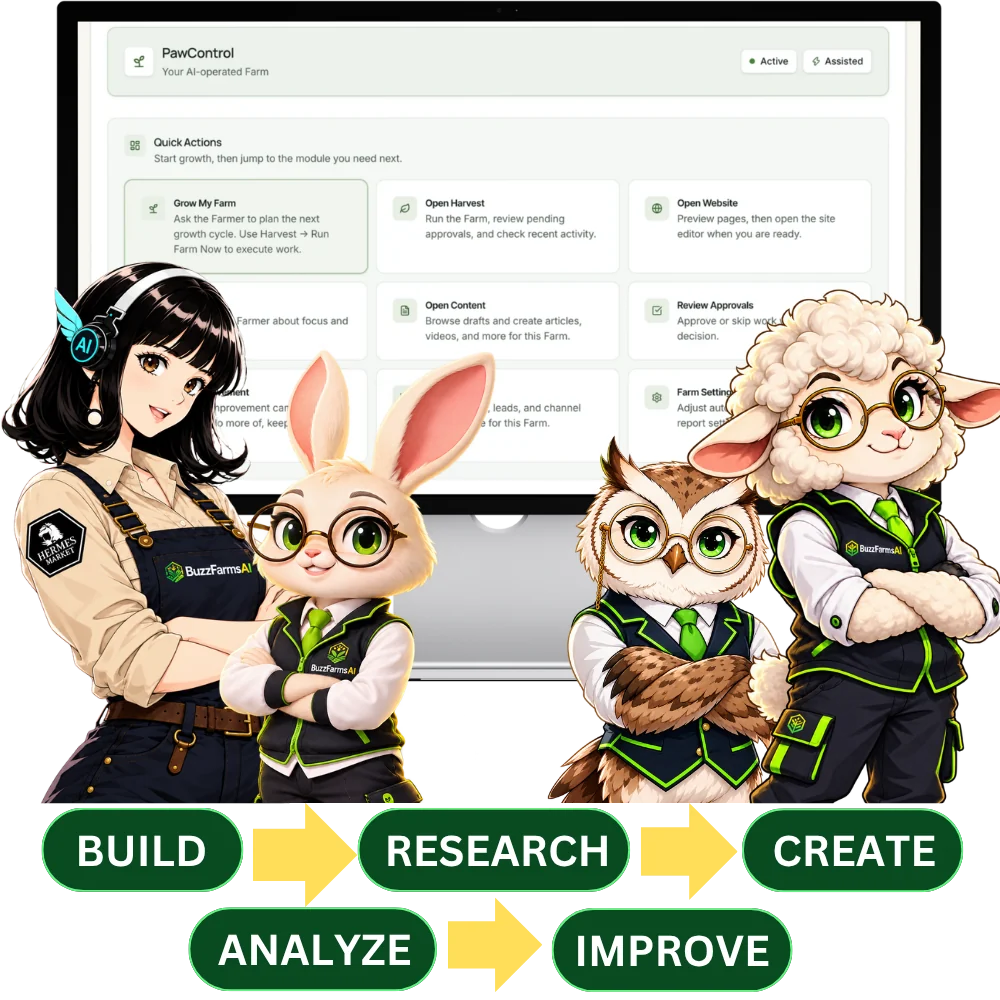
The seller's distinction is an ongoing Farm workflow rather than a collection of disconnected outputs. Its stated sequence connects the property, research, content, distribution and Harvest feedback. That may be attractive when maintaining those handoffs is itself the problem you are trying to solve.
A separately assembled stack can be sensible when you already have a reliable site and only need help with one task. Replacing everything to obtain a feature you could add separately may create unnecessary migration and learning work. Start by naming the gap rather than treating a new platform as the default answer.
Start with a short inventory of the work you already do. You may have a reliable website but repeatedly re-enter the same brief into content tools. You may prepare good articles but struggle to adapt and distribute them consistently. Or you may have a complete process that only needs one specialist capability. These situations create different buying cases, even when the product's feature list is the same.
BuzzFarmsAI's appeal is strongest when the relationship between tasks is itself the bottleneck. A common Farm context could reduce fragmented preparation and make the next action easier to organize. A separate tool may be better when the task is narrow and the surrounding process already works. This comparison evaluates operating approaches; it does not rank named competitors without verified evidence.
For the main recommendation and audience fit, read our complete BuzzFarmsAI review.
A responsibility-based comparison
This table compares approaches, not measured performance or a verified winner among named competing products. The BuzzFarmsAI column summarizes the documented concept; exact tools, package inclusions and integrations still require confirmation.
Compare complete workflows rather than isolated subscription prices. A writing tool may generate text but require you to supply the brief, publish the page and inspect later activity elsewhere. An integrated product may connect more of those stages while introducing its own limits and dependencies. The useful cost comparison includes the work you would still perform under each option, not just the number of advertised features.
Also compare failure handling. Where would you correct an outdated source? How would you stop an unsuitable scheduled action? Which system records the current approved facts? A process that is convenient when everything goes well may become difficult when information changes. These questions help evaluate the practical coordination benefit without assuming that either a single platform or a separate stack is automatically more reliable.
| Task | BuzzFarmsAI Farm concept | Separately assembled approach |
|---|---|---|
| Site structure | Farm models and coordinated property creation | Choose a site platform and organize the property yourself |
| Content | Workers use the Farm goal and supplied knowledge | Carry the brief between your chosen content tools |
| Opportunity research | A worker investigates relevant audience activity | Research sources and assess opportunities with your own process |
| Distribution | Owned publishing and prepared contributions in the described workflow | Connect destinations and manage each tool's publishing scope |
| Feedback | Harvest signals inform the coordinator's next activity | Define events and reconcile data across your reporting tools |
| Oversight | Assisted workflow and an advertised Approval Center | Design and maintain the review checkpoints between tools |
Choose around one clear marketing project
Match the connected Farm workflow to your audience, project scope and review capacity. The pricing guide explains the commercial details that still need confirmation.
View the BuzzFarmsAI offerWhen integration could be useful
Consider the Farm approach when repeated handoffs consume attention: the content writer lacks the current brief, the scheduler receives an outdated draft or the next article ignores what readers are asking. A shared goal and persistent context could make those relationships easier to manage.
The advantage should be tested against a real task. Ask how the workflow carries source information, what the reviewer sees and how recommendations become authorized activity. A demonstration of a coherent small assignment is more informative than a long list of possible business models.
Suppose an offer changes its billing arrangement. In a disconnected process, you may need to update a source note, several drafts, the published explanation and scheduled promotional material separately. A shared workflow is attractive if it helps keep those relationships visible. The supplied documentation does not establish that every dependency updates automatically, so a reviewer still needs to inspect the public result.
The same idea applies to audience learning. A useful question discovered during distribution can inform a guide, which can then support a better response. Connecting research and content may reduce the repeated work of explaining the project to several tools. This is the concrete convenience to investigate in a demonstration: does the system preserve useful context and organize the next task in a way that matches your work?
To understand the coordination the product is promising, explore the Farmer Agent and Farm Hands model.
When keeping your stack makes sense
A DIY setup may fit an established workflow, a specialist requirement or a team with clear responsibilities already in place. You can select each component around a precise need. That flexibility still comes with work: maintaining connections, passing context correctly and deciding which system is the source of truth.
An open agent framework is also not identical to a finished marketing application. Building the surrounding property, integrations, review flow and reporting can require additional implementation. Compare the whole supported workflow you need, not just whether a framework can theoretically perform a similar task.
Keeping a separate stack can make sense when you need a specialized publishing system, a particular integration or a team process already built around existing tools. A migration can introduce work that has little value if the current arrangement is dependable. Do not replace a functioning property solely to obtain an advertised capability that could be added more simply.
However, assembling tools also has a coordination cost. Someone must maintain the current brief, manage access, pass approved content between systems and reconcile reporting. If that work has become inconsistent or difficult to sustain, an integrated approach may deserve a serious comparison. The right answer depends on the actual effort and dependencies in your setup rather than a general preference for either automation or flexibility.
Use a short buying checklist
Write down what already works, which handoff is failing and the smallest change that would help. Then compare the learning, operating and migration work of each option. Do not count a promotional feature name as a confirmed entitlement or assume an integrated product removes every external cost.
For a practical evaluation, describe one complete project and trace it through both approaches. List the source preparation, output review, publishing, distribution and feedback steps. Mark what each option genuinely supplies and what remains your responsibility. Ask about the integration or allowance that would otherwise stop the project. This makes the comparison specific enough to support a purchase decision.
Then inspect the selected BuzzFarmsAI package. The advertised Premium entry amount, optional upgrades and Bundle range have different implications. A package with more client accounts or branding rights may matter to an agency but add little to a personal content property. Confirm billing and actual inclusions before claiming a saving against your current tools. A lower headline figure is not necessarily a lower total operating cost.
- Can the approach handle the specific property and deliverable you need?
- Are the required destinations and data sources supported?
- Can you maintain the level of review the work requires?
- What becomes dependent on another account, service or subscription?
- What remains usable if you later choose a different system?
For the financial side of that decision, consult the BuzzFarmsAI pricing and package guide.
Our recommendation by starting point
If you are starting a new property and want a connected process for site creation, content and supervised marketing activity, BuzzFarmsAI is worth shortlisting. Its Farm model gives those tasks a common purpose. Start with a defined audience and a deliverable you can review. The product is easier to evaluate when you know the job it should help you complete.
If you already have a strong site and a dependable production process, identify the missing task first. A specialist addition may be the simpler choice. Investigate BuzzFarmsAI when the shared-context and coordination benefits are substantial enough to justify learning another system. Preserve the requirements that matter, such as data access, client ownership and supported destinations, rather than giving them up for a longer feature list.
For an agency, the decision also depends on the service model and license. Client sites, client logins, output branding and software rebranding are different requirements. Read the commercial-rights guide alongside pricing, then inspect the relevant seller offer. Our Tried & liked verdict is a reason to examine the product's practical fit; your workload, existing tools and confirmed terms should determine the final choice.
Frequently asked questions
Is BuzzFarmsAI better than every separate AI tool?
That is not a defensible universal claim. The useful distinction is the coordinated Farm workflow; a specialist tool or an existing stack may suit a narrower requirement better.
Can I build a similar workflow myself?
A DIY approach can combine relevant components, but you remain responsible for implementation, connections, approvals and reporting. Compare that work with the actual supported product workflow.
Does one platform necessarily cost less?
Not necessarily. Confirm the exact offer, usage allowances and external dependencies, then compare the full cost of the tools and work you would actually use.
How do I compare the cost fairly?
List the actual tools and work required under each approach for the same project and period. Include confirmed subscriptions, usage, connected services, learning and maintenance effort. Do not add every advertised upgrade to one side while comparing only a single task on the other. Likewise, do not assume an integrated package includes every external dependency. Mark unanswered items and resolve the ones that determine suitability. This produces a fairer decision than comparing headline prices alone. A more expensive arrangement may be justified if it solves an important coordination problem, while a smaller specialist purchase may be preferable for a narrow gap.
What is a useful reason to switch?
Switch when the new process addresses a recurring problem strongly enough to justify the change. That might be repeated briefing, inconsistent source information or disconnected feedback. Describe the improvement you need before evaluating the new tool. Preserve requirements that already matter, such as supported destinations and client access. A new feature list is not a sufficient reason to disrupt a dependable workflow. BuzzFarmsAI deserves consideration for its connected Farm concept, but the decision should follow the project you operate. A clear requirement makes a positive purchase easier to justify and a decision to retain existing tools equally understandable.
Put this workflow in context
Read the complete BuzzFarmsAI review for our recommendation, product scope and buying considerations.
Choose around one clear marketing project
Match the connected Farm workflow to your audience, project scope and review capacity. The pricing guide explains the commercial details that still need confirmation.
View the BuzzFarmsAI offerEvidence and editorial scope
We tried BuzzFarmsAI and liked using it. This is qualitative publisher feedback, not a measured performance benchmark. Features are attributed to the seller; suggested workflows are guidance, not invented test logs or customer results.
The official product preview was reviewed for this edition dated November 14, 2026. Mixed pricing and unrelated copy in that preview are not treated as verified purchase terms. Official images are promotional illustrations, used with the publisher's reported permission.