
Give each piece a clear job
The seller describes researched topics, custom knowledge and brand voices as inputs to content creation. That is a promising way to keep material connected to the property rather than producing unrelated articles. It does not establish that every draft will be accurate, original or ready for a search result.
A review helps a buyer decide whether something fits. A tutorial helps complete a task. A comparison explains meaningful differences. Assign one main purpose to each page, answer that question early and remove sections that only repeat what another article already explains.
Content should answer the buying or service question that brought the visitor to the page. A useful pricing article explains what the payment buys and which charges repeat. A setup article helps someone prepare the right information. A comparison clarifies tradeoffs using consistent criteria. These are different jobs, so the same general introduction should not become the main substance of every page.
The seller advertises long-form branded content around a Farm's offer and audience. That capability is appealing when the project needs several connected explanations. Its value depends on whether the draft reflects accurate sources and helps the reader make progress. Word count alone cannot establish quality, and a fluent article can still omit the billing detail or practical limitation that determines a purchase decision.
For the complete feature and buyer-fit assessment, start with the main BuzzFarmsAI review.
An illustrative content brief
Suppose a garden-course Farm needs an article for someone planning a small balcony. This example is a planning aid, not a claimed BuzzFarmsAI run. A vague instruction to produce an SEO article could drift into unsupported climate advice or repeat a general gardening guide. A bounded brief gives the draft a more useful destination.
Include the intended reader, their uncertainty and the action the article supports in the brief. For example, someone considering a client-service tool may need to know the difference between creating a website and supplying a software account. An article that explains that distinction can address a real buying obstacle. A generic feature list may leave the same reader uncertain even when it is much longer.
Give the draft a source boundary. Identify which product details are confirmed, which are promotional descriptions and which remain unanswered. Ask for examples to be labeled as illustrative rather than presented as customer results. This helps the content stay persuasive through clarity. The reader can understand a practical use without being asked to trust an invented case study or a claim that the software guarantees demand.
| Brief element | Example instruction |
|---|---|
| Reader | A beginner choosing what to grow in a limited outdoor space |
| Question | What should be checked before selecting plants? |
| Evidence | Use approved course material and identify claims needing a reliable horticultural source |
| Useful output | A decision checklist covering light, space, access and maintenance |
| Boundary | Do not invent the reader's climate, measurements or likely harvest |
| Next step | Link a relevant planning resource, not an unrelated purchase pitch |
Before planning the article library, choose the right Farm structure.
Choose around one clear marketing project
Match the connected Farm workflow to your audience, project scope and review capacity. The pricing guide explains the commercial details that still need confirmation.
View the BuzzFarmsAI offerReview the claims, not just grammar
Check names, specifications, dates, prices and eligibility against their actual sources. A smooth sentence can still contain the wrong figure or describe a different product. Keep uncertainty visible when the evidence is incomplete; do not turn a seller's example into a customer result.
Add value the source text does not already provide: a practical selection framework, a clearly labelled example, a well-supported comparison or an explanation of who should choose a different approach. Preserve usage rights for images and supplied material. An AI draft does not create permission to reproduce someone else's work.
Review metadata and image descriptions as carefully as the article. A misleading title, invented rating or inaccurate image caption can misrepresent the page even when its body copy is cautious.
Review claims in groups rather than relying only on a spelling pass. First check product identity and terminology. Then check prices, billing, rights and allowances. Finally examine outcome claims such as speed, rankings or savings. An attractive phrase may imply more than its source supports. Replace vague certainty with the actual supported mechanism: coordinated preparation, reusable context or a clearer review process.
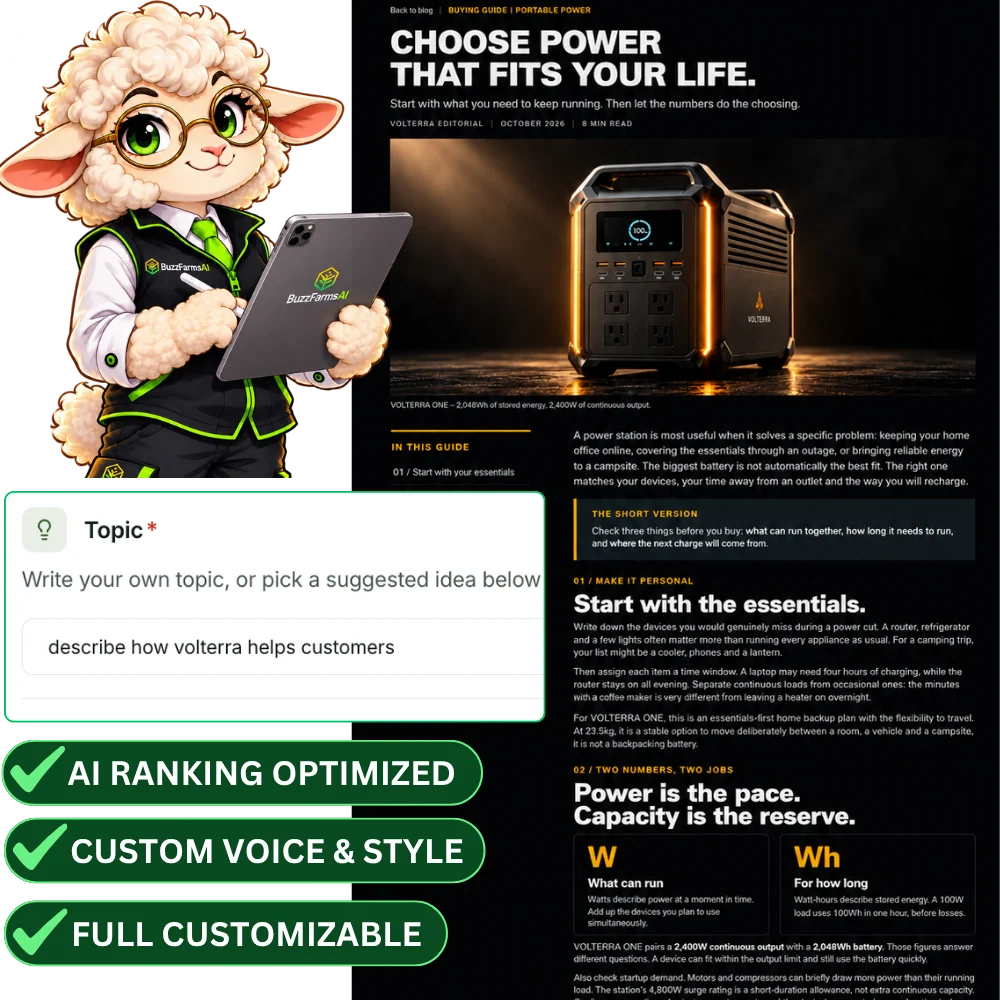
Images need the same attention. A promotional illustration can explain a workflow but should not be described as a screenshot from your own account. Product examples do not establish the results a new buyer will achieve. Use image descriptions that identify what is visible and why it matters. The surrounding article should explain the decision, allowing the image to support understanding rather than carry an unsupported proof claim.
AI output does not guarantee rankings
Google's guidance allows useful applications of generative AI but warns against creating many pages without adding value. It also calls for human checks of accuracy and trustworthiness, including metadata. The important distinction is not simply AI versus human writing; it is whether the finished page genuinely helps its reader.
Use descriptive headings, readable paragraphs, relevant internal links and an appropriate page title. Make images accessible and keep the information easy to find on a phone. These are sound publishing practices, not a promise that Google will index or rank a particular Farm.
For search visibility, organize each page around a distinct question and use the product name naturally where it identifies the subject. A descriptive title and a clear opening answer help readers understand the page before they commit to a long read. Subheadings should reflect actual decisions or steps. Repeating a keyword in every paragraph makes the explanation less natural without providing evidence of better rankings.
Internal links should connect the questions a reader is likely to ask next. A feature explanation can point to pricing when the capability depends on the chosen offer. A commercial-rights discussion can point to the agency workflow. Avoid adding a link solely because another page exists. The connection should have a reason that is understandable from the sentence, and the destination should deliver the answer the anchor promises.
Adapt the idea to the format
A video needs an intelligible spoken sequence; a PDF needs usable layout and working links; a social contribution must make sense without the full article around it. Reusing the underlying research can be efficient, but copying the same text into every format often produces a weaker result.
Before distribution, preview the finished asset, check its claims and decide where it is genuinely relevant. Content creation and permission to publish are separate steps, especially when a destination is a third-party community rather than your own property.
Reuse the verified idea across formats while adapting its presentation. A detailed article can support a short video outline or a downloadable checklist, but each format needs its own useful structure. A checklist should help someone perform or evaluate a task. A video should explain visually where possible. Copying a long paragraph into every format can create more assets without making the information easier to use.
Distribution also benefits from a source of approved facts. When the underlying price or product detail changes, revisit the formats that rely on it. The Farm's shared context is attractive because it can help organize this relationship. Confirm how the actual workflow handles revisions, and keep a human check on public claims. More efficient production is useful when the final information remains trustworthy and relevant.
To connect useful material with an appropriate destination, continue with traffic discovery and distribution planning.
A content plan that supports a buying decision
For an illustrative product Farm, start with an overview that explains the main use, intended audience and strongest limitation. Add a pricing guide covering the entry payment, optional upgrades and recurring obligations. Add a practical workflow article that helps a prospective buyer imagine using the product for a real task. These pages support different stages of the same decision without copying one another.
Next, identify an objection that deserves its own answer. Perhaps the reader needs client rights, a manageable approval process or a way to measure meaningful enquiries. Explain that topic with the available evidence and link it back to the overall review. A useful recommendation says when the capability matters, what still needs verification and which offer route the reader can inspect. This is more convincing than repeating a purchase button after every paragraph.
BuzzFarmsAI is worth investigating if maintaining this connected body of content is part of your actual work. Confirm the selected package's publishing and usage allowance before relying on an unlimited claim. Then evaluate the drafts for accuracy and usefulness. The commercial benefit to assess is a more organized production process, while search performance and sales remain outcomes that require real observation rather than promotional certainty.
Frequently asked questions
Can BuzzFarmsAI content automatically rank in Google?
No ranking outcome is established by a content-generation feature. Search visibility depends on the finished content, site quality, relevance and many other factors.
What formats does the seller describe?
The overview mentions articles, tutorials, comparisons, reviews, videos, PDFs and other educational or promotional material. Exact format limits and package inclusions still need offer-specific confirmation.
Should every AI-generated draft be published?
No. Publish only material that serves a distinct reader need, passes source and rights checks and has been reviewed in its finished format.
How can content persuade without sounding exaggerated?
Answer the objection that prevents a sensible purchase. Explain what the feature helps the reader do, when that benefit matters and what the selected package must include. Use a concrete example labeled as an example, then make the next step clear. A reader weighing cost needs billing and workload information more than another broad claim that the product is powerful. Natural persuasion respects those questions. It can recommend a suitable offer confidently while acknowledging a limitation that matters. Avoid invented results or unsupported urgency; they obscure the practical reason someone might choose the product in the first place.
What should be revised after an offer changes?
Inspect the pages and formats that depend on the changed fact. A price change may affect the main explanation, comparison table, FAQ and promotional drafts. A rights change may affect client-service recommendations. Update the source brief and review the public meaning of the revision, including any nearby qualification. The supplied material does not establish that every dependency is corrected automatically. A shared Farm context can help organize the work, while a person still checks the result. This ongoing accuracy is part of maintaining useful content, not a separate cosmetic step after generation.
Put this workflow in context
Read the complete BuzzFarmsAI review for our recommendation, product scope and buying considerations.
Choose around one clear marketing project
Match the connected Farm workflow to your audience, project scope and review capacity. The pricing guide explains the commercial details that still need confirmation.
View the BuzzFarmsAI offerEvidence and editorial scope
We tried BuzzFarmsAI and liked using it. This is qualitative publisher feedback, not a measured performance benchmark. Features are attributed to the seller; suggested workflows are guidance, not invented test logs or customer results.
The official product preview was reviewed for this edition dated November 14, 2026. Mixed pricing and unrelated copy in that preview are not treated as verified purchase terms. Official images are promotional illustrations, used with the publisher's reported permission.