ReferralNow's dashboard can organize referral activity, but a tracked sale is not automatically an additional sale and gross revenue is not profit. The useful result is a program that brings worthwhile customers at a cost the business can sustain.
We tried ReferralNow and liked its connected approach; our review does not claim a measured revenue lift. The figures in official dashboard images are demo data. This guide provides a measurement framework, not a customer case study.
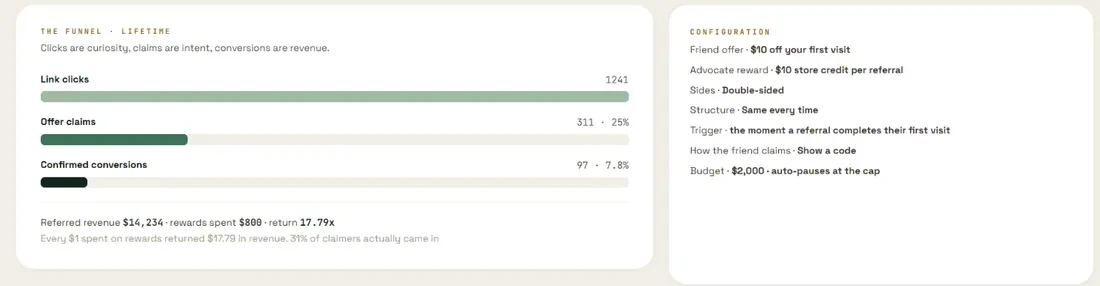
Define each stage before reporting it
The seller shows clicks, claims, confirmed customers and referred revenue, alongside campaign comparisons. Keep the definitions stable across reporting periods. If one report calls a claim a conversion and another requires a paid purchase, the trend is not comparable.
| Measure | Useful interpretation | Common mistake |
|---|---|---|
| Referral clicks | Interest in the shared route | Calling every click a new customer |
| Offer claims | People who claimed the friend offer | Counting claims as completed sales |
| Confirmed qualifying purchases | Recorded purchases that met the campaign rule | Ignoring later refunds |
| Referred revenue | Recorded sales value associated with referrals | Calling all of it profit or incremental revenue |
| Reward cost | Incentives earned or paid under the rules | Counting only cash already redeemed |
The workflow explanation follows these state changes. Decide whether a report uses initial confirmed purchases or purchases that have cleared the hold, and say which it is.
Use the funnel to find the real problem
If sharing produces clicks but few claims, inspect the offer page, relevance and clarity. If claims are healthy but purchases are weak, inspect eligibility, purchase friction and whether the claim attracted the intended customer. If many confirmed orders later reverse, inspect qualification and refund behavior.
Do not change the reward, invitation, audience and confirmation setup simultaneously and then attribute the difference to one feature. Keep a simple change log and use comparable periods, recognizing that seasonality and other promotions may still affect the outcome.
Calculate contribution, not just a revenue total
Use a business-level calculation: qualifying revenue minus refunds, variable product and fulfillment costs, friend benefits, advocate rewards, delivery costs and the relevant software or staff allocation. Include pending reward liabilities where they are likely to become payable.
For example, an illustrative—not measured—campaign might record $1,000 in sales, $600 in variable costs, $100 in friend incentives, $100 in advocate rewards and $30 in other campaign costs. That leaves $170 before any further overhead or tax, not $1,000 of profit. Actual inputs must come from the business's own records.
The reward budget guide explains why a free service, credit and cash should not be costed identically. The pricing guide identifies recurring software commitments.
Distinguish attribution from incrementality
Referral attribution answers which recorded route was associated with a purchase. Incrementality asks whether that purchase would otherwise have happened. An existing customer using a friend offer, a concurrent discount campaign or a customer already planning to buy can complicate the interpretation.
Where practical, compare against a meaningful baseline or a controlled business experiment rather than assuming every referred order is additional. Record the limits of the comparison. We did not verify a built-in causal-lift measurement feature and do not claim one here.
Build a useful owner or client report
Report the period, campaign, event definitions, confirmed purchases, refund adjustments, reward commitments and contribution assumptions. Finish with one decision: keep the offer, fix the weak stage or stop a campaign that cannot support its economics.
The seller places the monthly Report agent in Pro; dashboard access and an automated reporting feature should not be conflated. Agencies can use the client-workspace guide to assign responsibility for interpreting the data. The fraud guide explains why pending and rejected records deserve their own status rather than disappearing from the story.
Frequently asked questions
Are the screenshot figures Launch Review Lab's results?
No. They are official product demonstration data. No typical customer outcome or measured publisher revenue is inferred from them.
Does a referred sale prove the campaign created a new sale?
No. Attribution identifies an associated route; it does not establish what would have happened without the campaign.
Is the monthly Report agent in Premium?
The seller places that feature in Pro. Check the selected plan rather than assuming every automated reporting feature is part of Premium.
Choose the ReferralNow offer you need
Public order-form prices checked November 1, 2026, in USD before applicable taxes. Bundle and Whitelabel renew annually; the optional $97 Bundle training add-on is separate.
ReferralNow Premium
$49 single payment
1 business · 3 campaigns · 250 customers · 1 custom domain
View ReferralNow PremiumReferralNow Bundle
$497 every 12 months
Premium, Pro, Unlimited, Agency and Reseller; 50 reseller accounts
View the ReferralNow BundleReferralNow Whitelabel
$397 every 12 months
100 customer accounts under your brand and domain
View ReferralNow WhitelabelEvidence and editorial scope
We tried ReferralNow and liked its approach. This is qualitative publisher feedback, not a numerical rating, earnings claim or benchmark covering every plan. Seller-described capabilities and public order-form terms were checked November 1, 2026. Tutorials and calculations are suggested procedures or labeled illustrations, not invented test logs.
Official product images are used with the publisher's reported permission. Screens depict the seller's demonstration business and sample data, not our account results.
- Seller product description via the Premium offer
- Seller refund policy
- Seller terms of service
- Seller privacy policy
Editorial policy and review approach · Contact the editorial team