The best ReferralNow incentive is one that customers understand and the business can afford repeatedly. A large reward is not automatically persuasive, and a campaign that increases revenue while consuming its contribution margin is not necessarily successful.
Our ReferralNow review recommends the connected workflow. This guide addresses the economics of the promise inside it, using clearly labeled illustrative calculations rather than claimed product results.
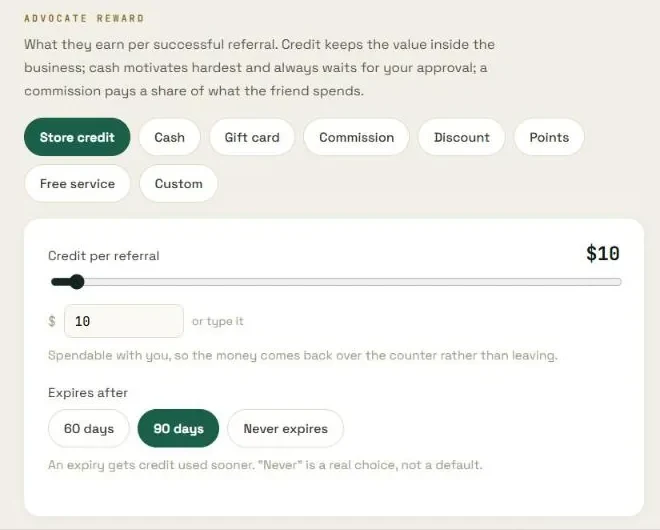
Choose the reward's operating cost
ReferralNow's core reward types include store credit, discounts, points, a free service and custom rewards. Pro adds real-money options such as cash-style rewards and connected payouts. A reward can benefit the advocate alone or form part of a two-sided offer with a friend benefit.
| Reward | Useful question before choosing it |
|---|---|
| Store credit | What future purchase can it be used against? |
| Discount | Does the reduced price leave adequate margin? |
| Points | What is the clear redemption value and rule? |
| Free service | Can staff fulfill it without displacing valuable capacity? |
| Custom reward | Who fulfills it and records completion? |
| Cash or gift-card-style reward | Does the selected plan support it, and who approves payment? |
Avoid treating the face value and economic cost as interchangeable. A free service uses time and supplies; credit may require a later purchase; cash leaves the business directly. The pricing guide explains the relevant feature boundaries.
Work backward from contribution
Here is an illustrative calculation, not a ReferralNow result. Suppose an eligible order brings $100 in revenue, with $60 in variable product and fulfillment costs. That leaves $40 before rewards, messaging, software allocation and support. A $10 friend discount plus a $10 advocate reward would reduce the available contribution to $20 before those other costs.
That example does not prescribe a universal reward percentage. Businesses have different repeat-purchase rates, margins and capacity. It shows why “$100 of referred revenue” should not be read as “$100 earned.” Include both sides of a two-sided offer in the cost, rather than counting only the advocate's benefit.
Set qualification before the amount
Specify what the business rewards: a first completed visit, a first eligible paid order or a defined recurring event. Include any minimum spend and exclusions. If a customer reads “earn $10” while the actual rule depends on an unstated future purchase, the copy needs revision.
Tiered and recurring incentives require especially clear timing. Explain whether a milestone counts qualified purchases or claims, whether tiers reset and what happens after a refund. Do not use a monthly-membership reward merely because the setting exists; match it to a supported billing and purchase-confirmation path.
The how-it-works guide separates those states, and the ecommerce guide covers online confirmation.
Limit exposure without breaking promises
ReferralNow demonstrates reward advice and a budget ceiling. Set a limit you can fund, decide what pauses when it is reached and make the advertised terms consistent with that behavior. A ceiling should not become an excuse to refuse rewards already earned under the campaign's rules.
Think in commitments as well as paid redemptions. Pending rewards may become payable after a hold. If the operator looks only at cash already spent, a successful invitation could create an unexpectedly large future obligation.
The seller's terms place responsibility for honoring rewards on the business. The wallet is an interface for balances and redemption; it is not a guarantee that the provider holds funds for every commitment.
Review reward quality, not just response volume
Watch the confirmed-purchase rate, refund rate, reward cost and customer questions. A campaign with many claims and few completed purchases may have an offer or qualification mismatch, not a need for a more expensive reward.
Keep approvals consistent using the fraud and hold guide, then assess the full economics with the analytics framework. Change one meaningful part of the offer at a time so the result is interpretable.
Frequently asked questions
Are cash rewards included in Premium?
The seller places real-money rewards and connected payouts in Pro. Premium's core rewards should not be described as including every payout option.
Does a bigger incentive guarantee more referrals?
No. Customer satisfaction, clarity, timing, trust and the effort required to redeem all influence participation. A larger incentive can also reduce the business's margin.
Does ReferralNow fund the rewards?
The terms make the business responsible for honoring its offers unless a particular feature expressly says otherwise. Budget for the commitment rather than assuming the software pays it.
Choose the ReferralNow offer you need
Public order-form prices checked November 1, 2026, in USD before applicable taxes. Bundle and Whitelabel renew annually; the optional $97 Bundle training add-on is separate.
ReferralNow Premium
$49 single payment
1 business · 3 campaigns · 250 customers · 1 custom domain
View ReferralNow PremiumReferralNow Bundle
$497 every 12 months
Premium, Pro, Unlimited, Agency and Reseller; 50 reseller accounts
View the ReferralNow BundleReferralNow Whitelabel
$397 every 12 months
100 customer accounts under your brand and domain
View ReferralNow WhitelabelEvidence and editorial scope
We tried ReferralNow and liked its approach. This is qualitative publisher feedback, not a numerical rating, earnings claim or benchmark covering every plan. Seller-described capabilities and public order-form terms were checked November 1, 2026. Tutorials and calculations are suggested procedures or labeled illustrations, not invented test logs.
Official product images are used with the publisher's reported permission. Screens depict the seller's demonstration business and sample data, not our account results.
- Seller product description via the Premium offer
- Seller refund policy
- Seller terms of service
- Seller privacy policy
Editorial policy and review approach · Contact the editorial team