ReferralNow describes a risk score, an approval queue and a holding period before reward release. These are tools for a controlled referral program, not proof that the system can eliminate fraud or that every flagged customer has done something wrong.
Our ReferralNow review is favorable, but reward approval is an operating responsibility. This guide explains how to use the seller-described controls without replacing judgment with a number.
A risk score is a reason to inspect
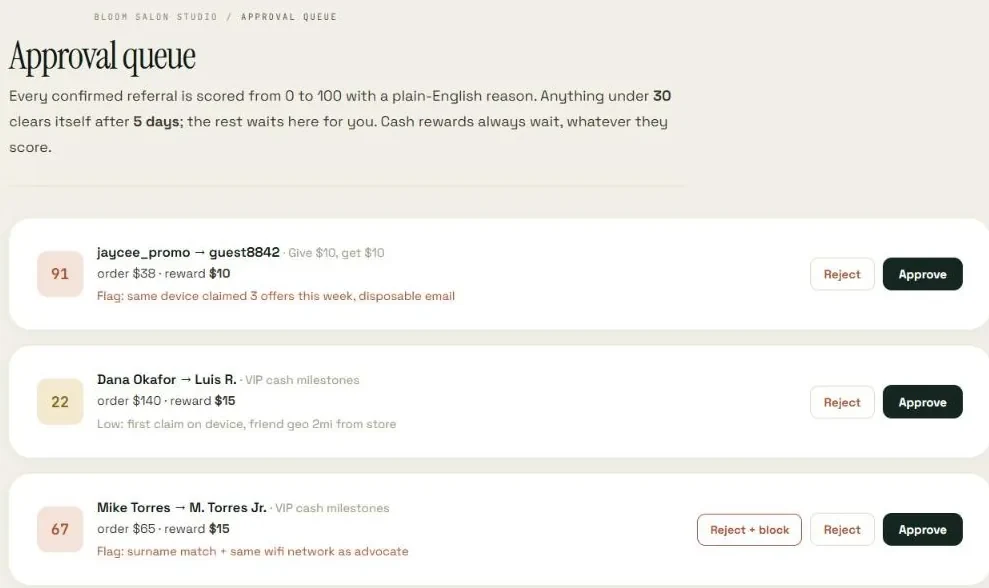
The official demo shows scores from 0 to 100 with plain-language reasons and approve, reject or block actions. A shared network, similar details or unusual referral volume may deserve review. None of those facts alone establishes a fraudulent purchase.
Read the reason and compare it with your campaign rules and the actual order record. A household may share a network; a busy customer may refer several genuine friends. Conversely, a low score does not guarantee that an order will remain paid or that the campaign rule was met.
Do not copy sample risk thresholds from a screenshot into your policy without checking your configured behavior. The demo's thresholds and waiting period illustrate that campaign, not a universal rule for every account.
Agree on a review policy before launch
Decide who can approve rewards, who handles disputes and what evidence is enough. Staff should not apply stricter terms after a customer has already completed the advertised qualifying action.
| Situation | Suggested review action |
|---|---|
| Duplicate order or confirmation | Match the stable order record before another reward is released |
| Similar advocate and friend details | Review the facts without assuming misconduct |
| Unpaid or canceled transaction | Apply the published qualifying-purchase rule |
| Refund during the hold | Check how eligibility and the wallet should change |
| Customer disputes a rejection | Explain the relevant rule and provide an escalation route |
These are suggested procedures, not claimed automatic product outcomes. The tutorial makes this policy part of first-campaign preparation.
Match the hold to actual refund behavior
A hold creates time to catch cancellations and refunds before rewards become usable. Set it with the business's transaction lifecycle in mind. The same waiting period may not suit an immediately delivered service and a shipped product with a longer return process.
Think through partial refunds, charge reversals and rewards already redeemed. We did not verify every connector's treatment of these cases. Ask about the exact platform behavior and keep an exception procedure rather than promising a fully automatic recovery.
The seller's software refund policy is a separate matter. A customer's refunded shop order affects referral eligibility; your refund request for buying ReferralNow follows the software seller's policy. Do not mix those two windows.
Use extra care with money-based rewards
Pro adds real-money reward options and connected payouts. The seller describes cash rewards as requiring human approval. Record the basis for the decision and check the destination and amount before authorizing a payment.
An approval action should be attributable to the operator who made it where the available account controls permit. Avoid broad shared administrator access merely to make the queue faster. The agency guide discusses role separation, while the privacy guide covers sensitive records.
Report exceptions as part of the program
Track pending, approved, rejected and refunded activity separately. A campaign that looks strong before refunds may look different once its liabilities settle. Consistent review also gives useful feedback: unclear wording can cause legitimate customers to trigger avoidable disputes.
Use the analytics guide to report that lifecycle and the reward guide to include pending commitments in the budget. The goal is a trustworthy program, not the highest possible automatic approval rate.
Frequently asked questions
Does a high score prove fraud?
No. It is a risk signal with a stated reason. Review the actual purchase and campaign rule before rejecting a customer's claim.
Does the demo's five-day hold apply to every campaign?
Do not assume so. The illustrated settings belong to the demonstration. Check the actual campaign configuration and the business's refund behavior.
Is fraud prevention a guarantee against losses?
No. Controls can support review and reduce avoidable mistakes, but the seller's terms do not establish error-free operation or guaranteed reward funding.
Choose the ReferralNow offer you need
Public order-form prices checked November 1, 2026, in USD before applicable taxes. Bundle and Whitelabel renew annually; the optional $97 Bundle training add-on is separate.
ReferralNow Premium
$49 single payment
1 business · 3 campaigns · 250 customers · 1 custom domain
View ReferralNow PremiumReferralNow Bundle
$497 every 12 months
Premium, Pro, Unlimited, Agency and Reseller; 50 reseller accounts
View the ReferralNow BundleReferralNow Whitelabel
$397 every 12 months
100 customer accounts under your brand and domain
View ReferralNow WhitelabelEvidence and editorial scope
We tried ReferralNow and liked its approach. This is qualitative publisher feedback, not a numerical rating, earnings claim or benchmark covering every plan. Seller-described capabilities and public order-form terms were checked November 1, 2026. Tutorials and calculations are suggested procedures or labeled illustrations, not invented test logs.
Official product images are used with the publisher's reported permission. Screens depict the seller's demonstration business and sample data, not our account results.
- Seller product description via the Premium offer
- Seller refund policy
- Seller terms of service
- Seller privacy policy
Editorial policy and review approach · Contact the editorial team