
Quick verdict: a red pin tells you where to investigate, not which change will produce a top-three result. ProfitMaps AI's documented grid and planning workflow can help organize that investigation. Our provisional 7.6/10 documentation-based assessment remains a workflow-fit judgement, not a verified ranking uplift or a promise that software can overcome distance.
The vendor advertises October 21, 2026 at 11 AM EDT and a $37 Basic entry offer. The published seller policy describes a 30-day money-back guarantee; neither the date nor that policy establishes an open cart or a completed refund test today.
Disclosure: purchase links may earn us a commission at no extra cost to you. The vendor screenshots are demonstrations, not our client results. Our sister property is not the official seller.
Start with the Finding, Not the Color
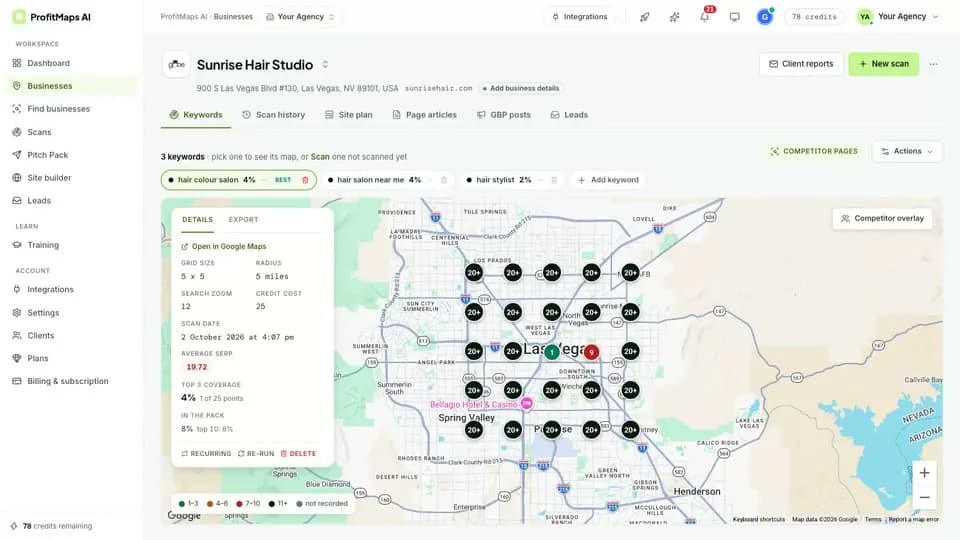
Before proposing a fix, confirm the listing, exact search phrase, coordinates, grid coverage, result depth and collection date. A weak point may represent distance, a mismatched query, competition, an incomplete profile or a collection issue. A color alone cannot distinguish those explanations. Our complete ProfitMaps AI review separates demonstrated interface capabilities from unresolved operating limits.
Keep the interpretation narrower than the sales pitch. A position outside the first three does not mean the business is absent everywhere, and a missing result within a scan's depth does not mean it has no customers. A query such as emergency plumber can have a different competitive map from bathroom installation. Use the grid audit framework to establish a baseline before this post-scan checklist.
Google describes local ranking in terms of relevance, distance and prominence. That is a useful organizing framework, not a formula with published weights. The practical job is to correct supported problems, improve useful information and measure consistently—not manufacture activity that looks like demand.
Step 1: Check Primary and Secondary Category Alignment
Compare the business's actual core activity with its primary category. Inspect relevant competitors to generate questions, not to copy their categories indiscriminately. A nearby practice offering orthodontics is not evidence that every dental office should select the same specialty.
Google's business representation guidelines advise specific, accurate categories rather than treating them as keyword fields. Record the present configuration and ask the owner which services are actually provided before proposing an edit. Do not add a category for a service the business merely refers elsewhere.
Prioritize a genuine mismatch over a speculative extra category. Document the reason, obtain approval and log the date. If several changes happen together, a later movement cannot identify which one mattered; your report should say what was implemented rather than claiming to have isolated a ranking factor.
Step 2: Improve Useful Local Service Pages, Not Doorway Variations
Map the search intent to a page that helps the visitor decide: service availability, real coverage, relevant qualifications, an understandable process and a working contact route. A neighborhood page needs information for that audience, not the same paragraph with a different place name repeated across dozens of URLs.
Keep address and business details consistent with the actual operation. Do not invent an office, staffed location or service presence to make a grid greener. A service-area statement describes coverage; it does not move the physical business closer to every searcher.
Structured data should accurately describe visible information. Google's LocalBusiness documentation explains supported properties; it does not promise that adding neighborhood markup expands Maps ranking reach. Validate the markup, but judge the page first by whether it answers a genuine customer's question.
If the website is outside your scope, deliver a clearly prioritized recommendation instead of changing hosting, DNS or account settings. The beginner freelancer guide explains how to separate a diagnostic service from implementation responsibilities.
Step 3: Build a Genuine Review Process and Helpful Replies
Ask eligible customers for honest feedback without incentives or pressure over what they write. Do not prescribe keywords, selectively route unhappy customers away from reviewing, or buy bursts of ratings for a weak neighborhood. Google prohibits fake engagement and rating manipulation in its Maps contribution policy.
Reply usefully and naturally. A response can thank someone and address a practical point without repeating service-and-city keywords. Never reveal private transaction details, health information or a person's history in order to demonstrate that you know the customer. Route sensitive concerns to an appropriate private channel.
Measure the quality of the operational process: are genuine customers receiving a reasonable invitation, and are responses timely and useful? Do not turn an arbitrary weekly review quota into a ranking guarantee. Review activity is only one part of the business's broader reputation and cannot erase physical distance.
Step 4: Keep Visual Assets and Customer Information Accurate
Use current, authorized photos showing the real team, premises or work. Check opening hours, booking links and service descriptions. A practical post can explain a genuine event or offer, but a weekly publishing calendar is a communication plan—not proof of a fixed Maps-ranking boost.
Answer real questions where the current interface permits it. Do not create fake customer accounts to seed questions, testimonials or engagement. If an FAQ belongs on the website, publish a transparent owner-authored answer there rather than pretending to be a customer.
Treat the software's suggested content as a draft. Check facts, media rights and tone before publishing. For regulated businesses, obtain the appropriate professional approval; an AI plan is not clinical or legal expertise. Our illustrative clinic audit shows how to keep those boundaries explicit.
Step 5: Correct Business Facts Without Manufacturing Signals
Verify the real business name, address where applicable, phone and website across important listings. Fix a documented inconsistency through the legitimate account process; do not create duplicate profiles or misleading virtual offices. Keep an audit trail so another provider can understand what changed.
Do not purchase simulated driving directions, fake clicks or fabricated visits. A report cannot establish that such activity is a legitimate ranking lever, and manufacturing customer behavior is not a service we recommend. Directions and calls from genuine customers can help assess customer activity, but they are not a reason to produce artificial engagement.
Revisit our main ProfitMaps AI assessment before treating an AI action list as fulfillment. The product can help communicate priorities; a qualified person still has to verify, authorize, implement and maintain the appropriate changes.
A Repeatable 30-Day Reporting Plan
| Checkpoint | Record | What it does not prove |
|---|---|---|
| Baseline | Same listing, keyword, coordinates and result depth | That every red point has the same cause |
| Implementation | Approved change, owner and completion date | That a change must improve rankings |
| Follow-up | Comparable scan settings and collection conditions | That a greener map equals new revenue |
| Business review | Agreed inquiry and conversion data | That every new customer came from Maps |
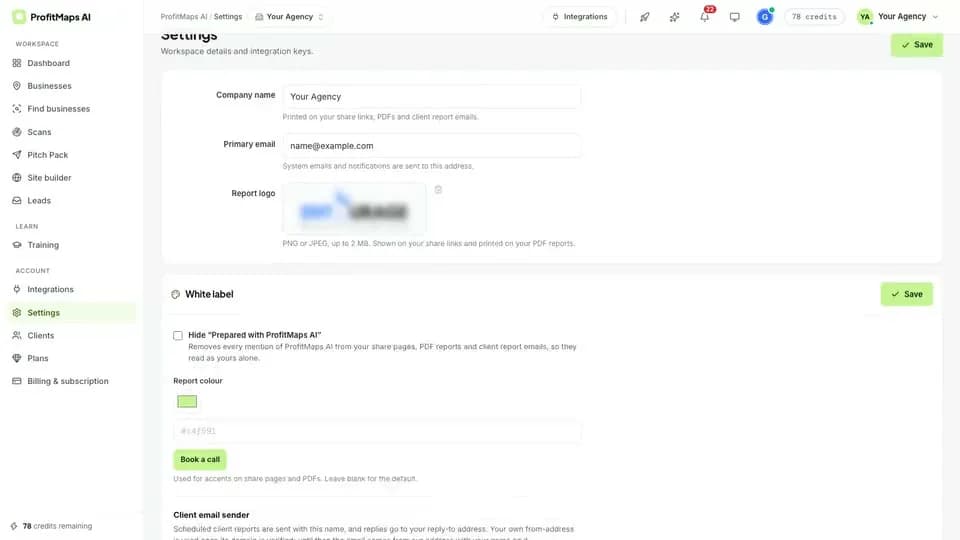
A thirty-day interval can be a useful reporting cadence, not an outcome deadline. Keep settings stable and log holidays, opening changes or major competitor developments. Report deteriorations and inconclusive results as openly as improvements. Avoid moving the grid center or reducing the radius to make the second picture look better.
If an illustrative 25-point baseline has five top-three positions and a later comparable scan has seven, coverage rises from 20% to 28%, an eight-percentage-point change. This arithmetic is not a ProfitMaps result or proof of causation. Revenue attribution requires separate records and an agreed method.
For additional context, our ProfitMaps AI sister research site explains the documented workspace; it is an owned publication, not official vendor documentation or an independent second test. Use the proximity-decay guide when distance is the central limitation, and the retainer playbook when scoping ongoing work.
Final Decision: Buy the Measurement Workflow, Deliver the SEO Work
ProfitMaps is worth shortlisting if a clear geographic diagnostic and proposal workflow solves a real gap in your service. Start with the smallest adequate licence after confirming actual checkout availability, included usage and export rights. Do not buy it on the assumption that a scan or generated plan automatically repairs rankings.
Keep the service promise concrete: a documented baseline, prioritized recommendations, approved implementation and honest follow-up. Check the seller's order-specific billing and guarantee conditions. No launch coupon, guaranteed green grid or measured client return is established by this checklist.
Sources checked October 19, 2026: official vendor launch specifications and seller refund policy. Release and prices remain advertised rather than checkout-confirmed; product documentation does not establish our hands-on results.
Frequently Asked Questions
Can ProfitMaps AI automatically turn every red pin green?
No verified evidence supports that promise. A grid is a diagnostic sample; relevance, distance, competition and business information all require interpretation. Appropriate implementation can be evaluated over time, but no tool can guarantee top-three coverage everywhere.
Should I add neighborhood keywords to every review reply?
No. Write helpful, truthful responses and protect private information. Request genuine customer feedback without incentives or prescribed content; keyword repetition and manufactured review activity are not a substitute for a sound business profile.
Does neighborhood schema expand my Maps service area?
Accurate structured data describes the real business and visible page information. It does not create a physical location or guarantee a wider Maps ranking footprint. Useful local content and valid markup should not be sold as a way to defeat distance.
Will a thirty-day rescan prove the client's ROI?
It can document a comparable visibility observation, not revenue by itself. Keep scan settings consistent and assess separately agreed inquiry, conversion and cost data. Report uncertainty rather than claiming every ranking movement caused a sale.