
Quick take: clients buy an accountable content service, not your generation button. TokMax AI's documented agency features are worth evaluating if branding, team roles and client access solve a recurring need. A $1,000 monthly package is a hypothetical scope-and-margin exercise here—not a reported sale, recommended universal price or guaranteed retainer.
The provisional product assessment remains 7.4/10. The vendor advertises October 24 at 11 AM EDT and $37 Creator entry with 10,000 one-time credits. No live cart, upgrade entitlement or finished agency implementation is verified by this guide. Disclosure: purchase links may earn us a commission at no extra cost to you.
Start with the Client's Bottleneck
A local business may need consistent explanations, service demonstrations or answers to common questions without filming a presenter every day. That does not mean every business wants daily faceless videos. Interview the owner about approvals, available footage, legal constraints, customer questions and where the audience actually watches before proposing a package.
The defensible service is editorial responsibility: briefing, sourcing, script accuracy, media permissions, reviewing output, organizing approval and reporting what actually happened. AI-assisted assembly can reduce some handoffs, but it does not remove those responsibilities. Avoid promising booked appointments, rankings or sales from the software alone.
Use our full TokMax AI review to evaluate the tool, then use this article to decide whether a service can be delivered profitably. For an individual creator's economics, the monetization guide covers a different model. Do not combine every business model into one client proposal.
Commercial Output Is Not the Same as White-Label Software
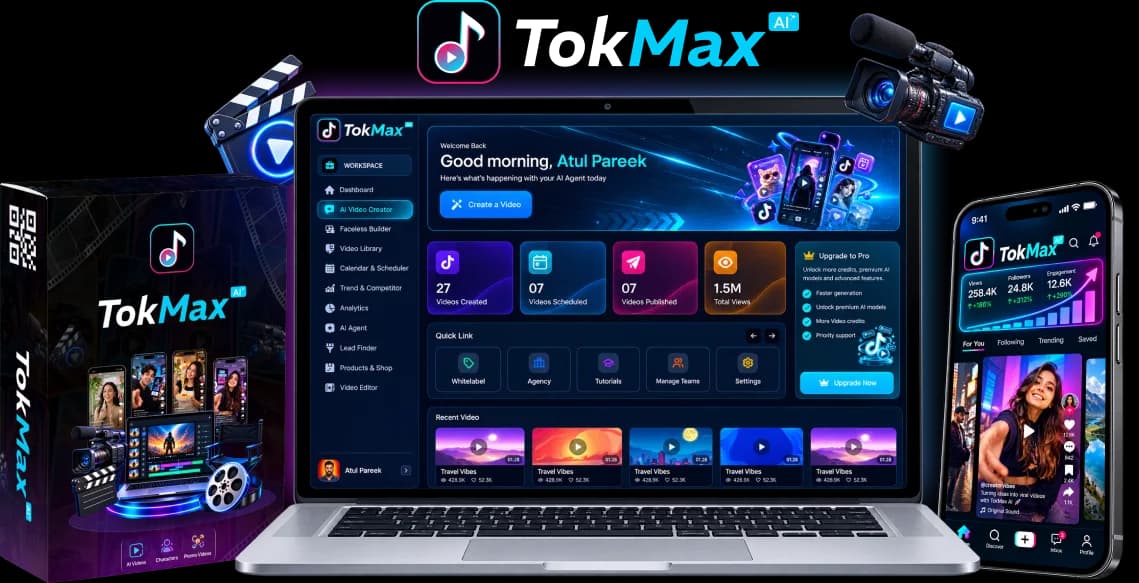
Creator's current vendor specification lists a commercial licence. In principle, that is the relevant starting question for producing permitted client deliverables, but the written licence must settle the exact rights. It does not by itself establish permission to resell software accounts, rename the dashboard, share credentials or offer unlimited seats.
The advertised $97 White Label Agency upgrade lists a branded dashboard, roles, client accounts, reporting and reseller-related rights. Those names need contractual interpretation. Confirm permitted client numbers, seat limits, brand removal, whether client workspaces are isolated and what happens when the underlying service changes. A marketing checklist is not a substitute for written terms.
The document checked October 17 now says “No Bundle Deal.” It lists a $230 Fast Pass combining upgrades one through five and a separate $147 Mega Bundle with 12,000 additional one-time credits and expanded-capacity claims. Do not treat $147 as the entire licence funnel. Compatibility, actual checkout total, resource limits and rights still require confirmation.
Our pricing and upgrade guide supplies broader context, but compare its dated information with the actual order. This new article records the current document's distinction rather than presenting old all-in assumptions as established entitlements. All purchase buttons use the existing primary tracker; there are no invented direct upgrade links.
Build an Approval-First Monthly Production System
Brief and Source Before Generating
Ask for the correct business name, service area, offer wording, exclusions, approved contact route and permitted media. Request proof for claims such as certification, price or availability. Keep a separate prohibited-claims list. For clinics, financial services or other sensitive sectors, qualified review may be necessary before even drafting a hook.
Create an idea sheet organized around customer questions rather than thirty variations of “buy now.” Give each video one purpose, one evidence item and one next step. Reserve a content slot for changes or seasonal corrections. A monthly calendar should reflect an editorial plan, not just a count of available upload times.
Approve Scripts, Then Produce Small Batches
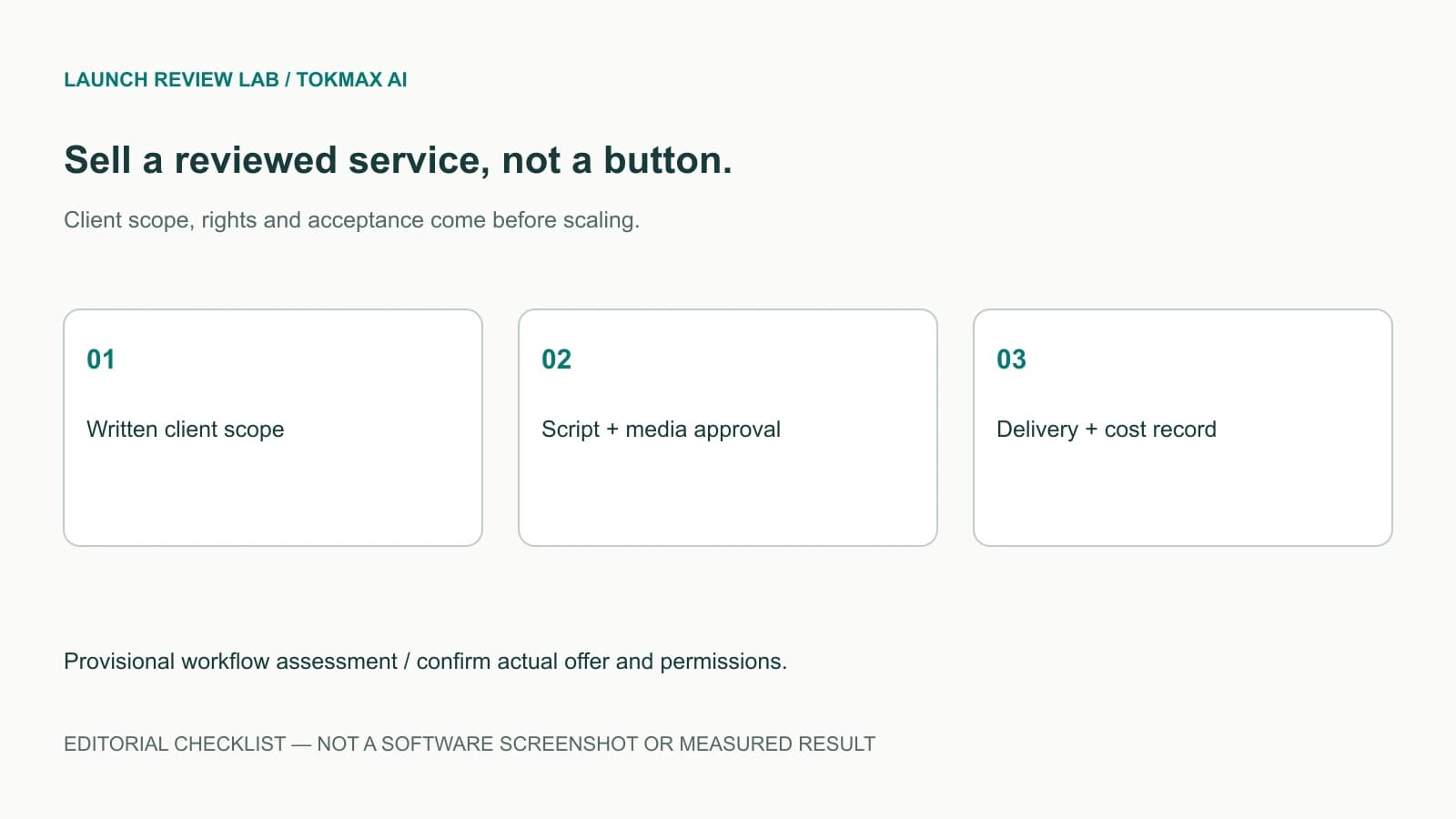
Secure approval for the message before spending generation credits. Group accepted scripts by format, narration style and media needs, then render a small initial batch to establish whether the output is acceptable. A client discovering an incorrect offer after thirty renders is an avoidable production problem.
The suggested “30 videos in 60 minutes” is not a verified TokMax benchmark. Briefing, approvals, fact checking, rendering, revisions and publishing take different amounts of time. Track your actual minutes per accepted video before committing to a client turnaround; do not sell a vendor's automation claim as your service-level agreement.
Review, Deliver and Verify Publication
Inspect every export for factual accuracy, branding, captions, voice, music rights and crop safety. Obtain written approval before scheduling to a client's account. Confirm who owns the account and who can revoke access. Deliver a copy of the finished files and maintain a clear distinction between “approved,” “scheduled” and “published.”
TikTok connection permissions and final post state remain separate from video generation. A calendar entry is not evidence of public publication, and an account connection is not permission to publish unapproved material. Our workflow guide explains the sequence; our publishing-risk checklist covers the boundaries.
Price the Scope Before Picking a Retainer Number
| Example service component | Define it in the proposal | Why it matters |
|---|---|---|
| Deliverables | Number, approximate duration and supported formats | Prevents “unlimited video” expectations |
| Research and scripting | Topics, source responsibilities and approvals | Protects against invented business claims |
| Production | Permitted stock/custom assets and branding | Rights and complexity affect cost |
| Revisions | A defined number of consolidated rounds | Stops unlimited rework |
| Publishing | Account, approval deadline and failure handling | Scheduling is not guaranteed distribution |
| Reporting | Actual posts and meaningful observations | Views are not automatically attributable sales |
A fictional $1,000 monthly package with $150 of direct resource costs and fifteen hours of work leaves $850 before overhead, tax and unpaid administration. That is about $56.67 per work hour before those deductions. If revisions double labour to thirty hours, the same calculation falls to about $28.33. These are arithmetic examples, not market rates, profit promises or TokMax costs.
A $500 or $1,500 proposal might be appropriate for a different scope, but the number should come from client value, your delivery cost and a clearly agreed responsibility split. Do not underprice the human work because the software entry offer is $37. Tools are only one line of the service budget.
Protect Credits and Client Separation
Budget using total credits consumed per approved deliverable, not per first draft. Confirm whether re-renders, additional voices, media generation and failed jobs consume resources. The 10,000 Creator credits and 12,000 Mega allocation are advertised one-time balances, not monthly recurring agency capacity.
Maintain a per-client ledger even if the software exposes a shared meter. Record job, credits, approval status and revision reason without storing unnecessary personal information. Separate client media, contacts and credentials. A “create client accounts” claim does not prove isolation, granular permissions or a specific data-processing contract.
Ask the vendor what clients see, who can download assets, how access is revoked and what survives cancellation or non-renewal if applicable. Use sanitized examples when contacting support; never send a client's TikTok password or token. The login and dashboard guide includes an entitlement and support checklist.
Who Should Consider the Agency Upgrade?
Consider a higher tier when a verified requirement—client access, branding, team roles or a resource ceiling—blocks work you already know how to sell and deliver. Start with a paid pilot only when the live licence permits the work and the client understands the scope. The agency label alone does not create a pipeline of customers.
Skip the white-label purchase if all you need is producing a few finished videos and handing over the files. Confirm the core commercial terms first. Reselling software and running a production service are materially different obligations, particularly for support, access and customer expectations.
Return to our main TokMax buying assessment before committing. The sensible upgrade is the one that removes a documented operational constraint at a sustainable cost—not whichever bundle title sounds most complete. Preserve human approvals and avoid guaranteed growth or revenue language in the client offer.
Sources checked October 17: official launch page and vendor product/licence descriptions. No client revenue, delivery-time benchmark or paid upgrade test is asserted.
Frequently Asked Questions
Does the Creator commercial licence include a branded dashboard?
The current document lists commercial use in Creator and branded-dashboard/agency features in a separate upgrade. Confirm the written licence and actual tier before promising software access, rebranding, seats or resale rights to clients.
Can I reliably deliver thirty videos in one hour?
No verified benchmark establishes that. A full service includes briefing, rights, approvals, corrections and publishing checks in addition to generation. Measure a representative paid pilot before offering a turnaround commitment or monthly volume.
Is a $1,000 retainer a realistic guaranteed outcome?
It is only a hypothetical package-planning amount here. Price depends on scope, demand, client value and delivery cost, and no client acquisition or recurring income is guaranteed by purchasing TokMax or an agency upgrade.
Should agencies automatically choose the $147 Mega Bundle?
No. The current vendor document lists it separately from Fast Pass and describes additional credits and capacity. Verify compatible licences, client rights, actual limits and order terms; it is not established as the complete software funnel.