
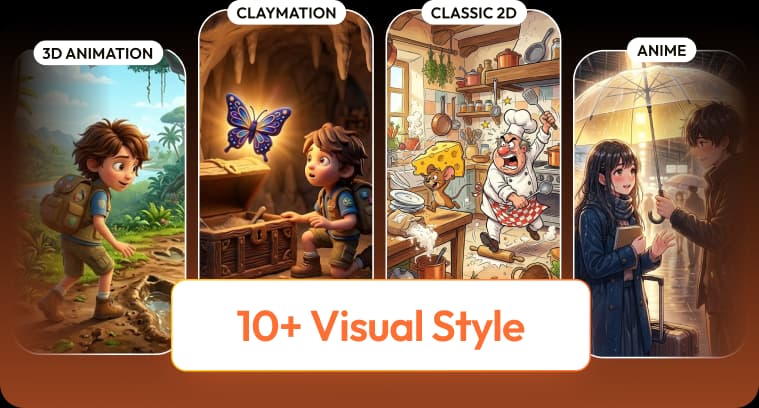
RocketToons animation styles give a story its visual identity before the audience hears a word. The official overview presents a range of treatments, including dimensional cartoons, classic 2D, storybook, anime, comic-book and clay-like looks. Different packages are described as adding further choices.
The sources do not use one consistent total for every package, so this guide does not turn the largest style count into an entry-plan promise. It explains how to select a coherent treatment and evaluate it. Our RocketToons review covers the full product assessment.
We may earn a commission if you purchase through links on this page, at no extra cost to you.
Start with readability, not the most elaborate preview
Ask where the film will be watched. A detailed background that looks impressive on a desktop can distract from a small character on a phone. For short instructional content, clear silhouettes and simple visual hierarchy can matter more than decorative texture. For a story-led film, a richer setting may contribute to the mood.
Pick a reference scene with the actual cast and an important prop. Judge the style on that task, not only on an unrelated promotional example. Can you identify the hero at a glance? Does the environment support the action? Are the essential objects distinct at the intended viewing size?
Compare visual approaches by communication job
| Visual approach | Useful question before choosing it |
|---|---|
| Flat or classic 2D | Will simplified shapes make the process easier to follow? |
| Dimensional cartoon | Does depth help the characters and physical action read clearly? |
| Storybook treatment | Does an illustrated atmosphere support the narrative? |
| Anime-inspired treatment | Does its visual energy fit the audience and tone? |
| Comic-book treatment | Can panel-like emphasis clarify the key moment? |
| Clay-like treatment | Does a tactile appearance contribute to the story's character? |
These are editorial selection questions, not claims that any treatment guarantees better engagement. A style succeeds when it fits the content, not merely because its name is familiar.

Use style labels without copying protected identities
Some official style names reference well-known animation traditions or studios. A stylistic label is not permission to copy a protected character, logo or recognizable franchise scene. Build original characters and provide your own creative direction. Avoid presenting the resulting video as produced or endorsed by a named studio.
For commercial work, use descriptive visual language where possible: rounded dimensional characters, soft illustrated textures or bold graphic outlines. The commercial-licence guide distinguishes the software licence from the rights needed for the material you upload and distribute.
Keep the cast and environment in the same visual world
Style changes can alter apparent age, facial shape and proportions. Once you approve a cast, inspect the same characters in the chosen treatment before generating every scene. A reference that works in one visual approach may not carry over without review.
Check environments and props too. If the hero has a simple cartoon design but the location is highly realistic, decide whether that contrast is intentional. The character-consistency guide provides a useful identity checklist. Keep the film's visual rules stable unless the story specifically calls for a change.
Test one representative scene before a full film
Choose a scene that contains the main challenge: conversation, movement, a close-up or an important object interaction. Review its still before motion. That lets you inspect the palette, character proportions and composition without committing to the full sequence.
When comparing two directions, keep the story brief as similar as possible. Changing the cast, camera, setting and style at once makes it difficult to know why you prefer one result. You do not need a formal performance experiment to make a creative decision; you need a clear comparison that answers your production question.
Document the choice for future episodes
Save the approved style, cast and palette as part of your series notes. Record practical decisions such as the usual shot distance and whether backgrounds should remain simple. A new episode then starts with an established visual language rather than an entirely new aesthetic search.
For a client, show an approved style reference before promising a finished sequence. Explain that a later style replacement can require new images and animation rather than a minor export adjustment. RocketToons offers creative flexibility, but a clear approval process is what turns that flexibility into a manageable production workflow.
Frequently asked questions
How many styles does the entry package include?
The supplied sources use different counts and package descriptions. Confirm the exact current selection for your order rather than relying on the largest advertised number.
Which style gets the most views?
We have no measured evidence establishing a universal winner. Choose for audience, subject, clarity and the type of story you want to tell.
Can I reproduce famous cartoon characters?
A style option does not grant rights to protected characters or imply permission from another studio. Use original or properly licensed material.
Can a series use different styles?
Yes as a creative plan, but identity and continuity should be reviewed. Do not assume a saved cast will look identical after a major style change.
Product information and review scope
Product information checked October 24, 2026 against the official product specifications and supplied product material. Official descriptions inform the feature breakdown; they are not independent evidence of results. Where the sources disagree on package allowances, this guide preserves the uncertainty rather than choosing the most generous figure.
We tried RocketToons and liked using it. That qualitative experience is separate from package documentation and does not establish testing of every optional module, a paid-checkout verification, a measured outcome or a particular refund period. Use the official purchase route for current availability and the selected order's terms.