
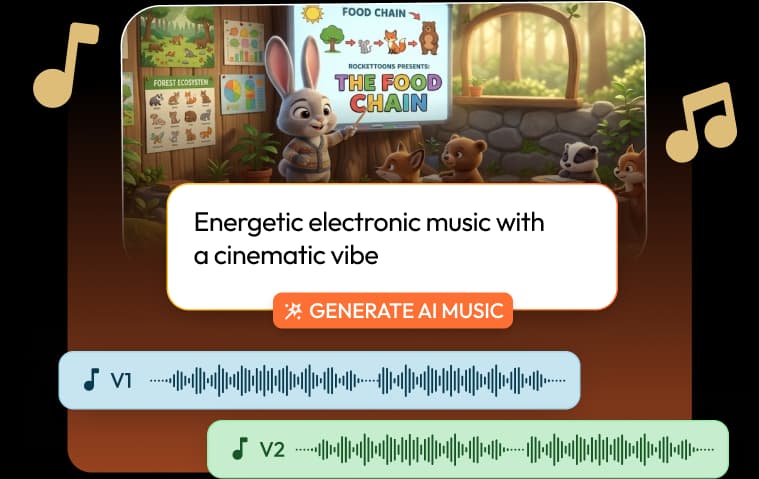
RocketToons music should support the story rather than compete with it. The official overview describes background tracks and AI-composed scores, with advanced audio capabilities attached to optional packages. These are different tools: selecting an existing track is not the same production decision as generating a new composition.
This guide explains how to choose and review a soundtrack without inventing music-quality benchmarks or licence terms. For the overall product recommendation, see our RocketToons review. For spoken audio, use the separate voiceover guide.
We may earn a commission if you purchase through links on this page, at no extra cost to you.
Give the soundtrack one clear job
Decide what the scene needs emotionally. A gentle background can support a calm explanation; a change in energy can signal a reveal or transition. Avoid asking music to create excitement where the script has no meaningful event. The audience should understand the story without relying on a dramatic track to explain it.
Write a short musical brief containing mood, energy and where the important change happens. “Warm and curious, quiet under the narrator, with a small lift at the discovery” is more useful than “make it epic.” It gives you a concrete basis for selecting a library track or assessing a generated score.
Library track or original composition?
An existing track can suit a straightforward project where speed and predictability matter. A composed score may help when you need a more specific mood or structure. Neither option is automatically superior. Listen to how the music fits the actual narration and edit, not just how impressive it sounds alone.
The official overview lists a track collection and describes custom composition under Pro, while other supplied material organizes audio features differently. Confirm your selected package before assuming that a composer or particular library is included. Our pricing guide separates advertised package costs from unresolved entitlement details.

Leave room for words
Spoken meaning comes first in an explainer. A busy melody or strong beat can make a perfectly understandable voice harder to follow. Review the scene with both elements playing together. If you strain to hear a name, instruction or number, simplify the soundtrack or adjust it using the controls your workflow provides.
Do not judge the mix only with high-quality headphones. Try ordinary laptop or phone speakers too. The practical test is whether the intended audience can follow the words comfortably. We do not claim a specific loudness target, automatic mastering standard or measured audio advantage for RocketToons without supporting technical evidence.
Use transitions and silence intentionally
Not every scene needs music from beginning to end. A brief quiet moment can focus attention on a line or a visual event. Similarly, a transition does not need a loud effect every time the camera changes. Repetition can make a short cartoon feel more cluttered rather than more polished.
Watch the whole sequence and note where the music starts, changes and ends. A track that stops abruptly before the last line can weaken the ending. A very long introduction can delay the story. Trim or replace elements based on the film's structure, and check the final export rather than relying only on the editing preview.
Check music rights and account conditions
An advertised commercial video licence does not by itself explain every term governing uploaded songs, generated tracks or third-party audio. Read the applicable package and asset conditions. If you bring your own music, confirm that its licence covers the intended distribution, clients and monetization arrangement.
Do not promise that a track can never receive a platform claim or that generated music establishes exclusive ownership. Those are separate legal and platform questions. Keep the source and licence information with the project. The commercial-rights guide explains how to distinguish software permission from the rights to individual ingredients.
Finish with a repeatable listening checklist
Review the opening, the busiest dialogue moment and the final sentence. Listen for unwanted overlaps, clipped words and music that draws attention away from the message. Confirm that each change is intentional and that a corrected scene has not introduced a new audio mismatch.
Save an approved export and keep notes about the music source and relevant settings. For a recurring series, a consistent musical identity can help episodes feel related, but it should not prevent adapting the mix to a particular scene. Our editing and export guide completes the delivery checklist.
Frequently asked questions
Is custom AI music included in every package?
Do not assume so. The current overview and supplied specification organize audio features differently. Confirm the composer and library entitlements for your selected purchase.
Is a generated score always better than a library track?
No. Choose the option that supports the story and dialogue. A simple, well-matched track can be more useful than a distracting custom composition.
Can we guarantee no copyright claims?
No. Verify the applicable rights and platform conditions. We do not promise exclusive ownership or immunity from claims.
Should music play under every spoken line?
Not necessarily. Use music where it contributes and leave room for important words, pauses and visual events.
Product information and review scope
Product information checked October 24, 2026 against the official product specifications and supplied product material. Official descriptions inform the feature breakdown; they are not independent evidence of results. Where the sources disagree on package allowances, this guide preserves the uncertainty rather than choosing the most generous figure.
We tried RocketToons and liked using it. That qualitative experience is separate from package documentation and does not establish testing of every optional module, a paid-checkout verification, a measured outcome or a particular refund period. Use the official purchase route for current availability and the selected order's terms.