
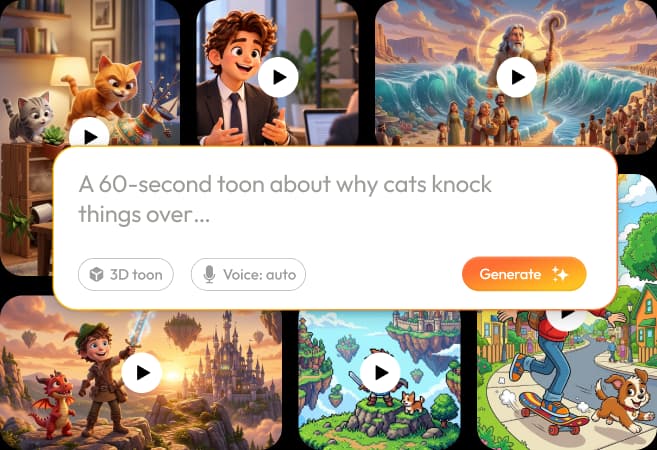
RocketToons script writing is most useful when it gives an idea a production-ready shape. The official specifications describe an AI story writer, editable outlines and multiple formats, including stories, explainers, biographies, skits, quizzes and countdowns. A format is a storytelling structure, not a substitute for a clear purpose.
The broader RocketToons review covers the buying decision. This guide focuses on what to ask the story writer, what to remove from its draft and how to prepare scenes that can be animated coherently.
We may earn a commission if you purchase through links on this page, at no extra cost to you.
Match the format to the audience's question
Choose an explainer when the viewer needs to understand a process. Choose a story when the viewer should follow a character through an event. A quiz suits a specific question with an answer worth considering; a countdown suits comparable items that can be meaningfully ordered. Do not force a simple instruction into a dramatic story merely because the option is available.
Write the intended takeaway first. “Understand why a plant needs drainage” is clearer than “make a viral gardening cartoon.” The first brief gives the script a testable communication objective. The second asks the software to predict audience response, which it cannot establish merely by producing a draft.
Give the writer useful constraints
Specify audience, tone, setting, cast size and the one event or explanation the film should contain. State which facts must remain accurate and which elements can be fictional. For a business explainer, provide real product facts rather than asking the writer to invent benefits or customer testimony.
A practical original brief might ask for a friendly robot to explain one recycling mistake using a single household scene. That is a suggested exercise, not a report of our output. Keep the initial request small enough that you can check every claim and action. Add complexity after the basic outline works, not before.

Edit the outline before polishing dialogue
Read the sequence as a chain of visible changes. What does each scene introduce? Why does the next scene follow? Can two scenes be combined without losing meaning? A long outline can feel productive while hiding repetition. Remove scenes that merely restate narration without adding a visual event.
For a short story, identify setup, change and resolution. For an explainer, identify question, demonstration and takeaway. These structures need not become rigid formulas. They simply let you see whether the draft has a direction. Our beginner workflow places this outline review before character and motion work.
Write scenes that show rather than only announce
Replace vague instructions with actions a viewer can recognize. “The character feels prepared” is difficult to evaluate; “the character checks the map, packs the bag and points to the route” is a sequence of visible decisions. Use only the actions the shot has time to communicate clearly.
Separate narration from dialogue and action. If the narrator explains a process while a character performs an unrelated joke, decide which element deserves attention. A scene can support more than one purpose, but the audience should not have to choose between conflicting messages. This becomes especially important when adapting a widescreen film into a vertical short.
Keep dialogue speakable and verifiable
Read each line aloud. Shorten sentences that contain several subordinate clauses or too many unfamiliar terms. Give different speakers a reason to exchange lines rather than splitting one lecture into arbitrary voices. Pronunciation, names and factual numbers need a deliberate check before audio generation.
For educational or professional subjects, have a knowledgeable person review the script. A generated biography should not invent quotations, and a product explanation should not imply endorsements or capabilities that do not exist. Our voiceover guide explains how to preserve meaning during casting and localization.
Finish with an earned ending
The ending should resolve the question or event introduced at the start. If the film explains one concept, summarize that concept in plain language. If it promotes a legitimate service, use a relevant next action rather than a sudden unrelated sales pitch. Avoid introducing a new claim in the final seconds without time to support it.
Before approving the storyboard, check rights, accuracy, cast size and unnecessary scenes. Keep the final script version alongside the exported film. A clear record helps when a client requests changes or when you prepare a related episode. The story writer is a drafting tool; your editorial judgment turns the draft into a useful communication asset.
Frequently asked questions
Which story formats are documented?
The supplied specifications describe formats including stories, explainers, biographies, skits, songs, quizzes, countdowns and what-if concepts. Check the current account for the exact available menu.
Can I use my own script?
The official overview describes using an idea or script. Review the resulting outline rather than assuming your original wording will pass through every stage unchanged.
Does AI writing remove the need for fact-checking?
No. Check factual statements, quotations, product claims and any professional guidance before they appear in a finished video.
Should every cartoon contain a purchase message?
No. Match the ending to the purpose. A clear lesson, a satisfying story or a relevant next action can each be appropriate.
Product information and review scope
Product information checked October 24, 2026 against the official product specifications and supplied product material. Official descriptions inform the feature breakdown; they are not independent evidence of results. Where the sources disagree on package allowances, this guide preserves the uncertainty rather than choosing the most generous figure.
We tried RocketToons and liked using it. That qualitative experience is separate from package documentation and does not establish testing of every optional module, a paid-checkout verification, a measured outcome or a particular refund period. Use the official purchase route for current availability and the selected order's terms.